
Self-report & Earth Link
Two features of the Astronaut Health Intelligence Platform (AHI) address the hazards of isolation and confinement and distance from Earth. Background on both hazards: Spaceflight health hazards.
Self-report
What it does
A 30 second daily check-in, simplified in the style of the NASA Standard Measures, captures mood, fatigue, stress, sleep quality and symptoms. The answers are compared with the person's own previous answers and corroborate objective signals; they never raise an alert on their own.
Inputs
| Question | Scale (1 to 5) |
|---|---|
| How is your mood? | Very low, Low, Okay, Good, Very good |
| How tired do you feel? | Rested, Slightly tired, Tired, Very tired, Exhausted |
| How stressed do you feel? | Calm, A little, Moderate, High, Very high |
| How well did you sleep? | Very poorly, Poorly, Fair, Well, Very well |
Plus optional symptom tags and a free note. Record format: Data dictionary.
- Simulated check-ins: one per astronaut each sim morning at about 07:00 UTC (personal offset of plus or minus 20 min), for the 14 pre-generated days and live. Answers follow the simulated state with seeded noise: progressive fatigue raises fatigue and stress and lowers mood and sleep quality; cabin CO2 makes a reported headache much more likely; exercise decline adds muscle soreness; sleep quality follows last night's efficiency and duration.
- Manual check-ins typed in the UI are
MANUALand replace that UTC day's simulated check-in.
Method
Mood, fatigue and stress become the MOOD, PERCEIVED_FATIGUE and STRESS metrics (brain region), handled as daily metrics with a personal baseline:
band = median of own answers +/- 2 x max(1.4826 x MAD, 0.75)
     = median +/- 1.5 when answers are very consistent (MAD = 0)
Integer answers often give a MAD of 0, so the floor of 0.75 sets the band. One answer 2 points away is outside the band. Two check-ins in a row outside the band, or one answer 3 points away, is MODERATE (rules R-PSY-01 to R-PSY-03).
| Rule of self report | Effect |
|---|---|
| Capped at MODERATE | maxLevel on the three metrics |
| One shared weight in the score | A check-in alone reaches MODERATE at most |
| Never raises an alert | Creates onboard recommendations only |
| Corroboration | High fatigue (4 or 5) in the last 2 check-ins adds a factor to R-FAT-01 without raising its level |
| Symptoms (R-PSY-04) | Informational factor, weight 0.05, for example "You reported a headache today"; never a diagnosis |
Outputs
Check-in records (CheckIn), self report metric states, R-PSY factors and recommendations, audit events CHECKIN_RECORDED, timeline markers.
Limitations
Self report is subjective; the simulated answers are a model of how people might answer; the scale is a simplification, not a validated questionnaire.
Earth link
What it does
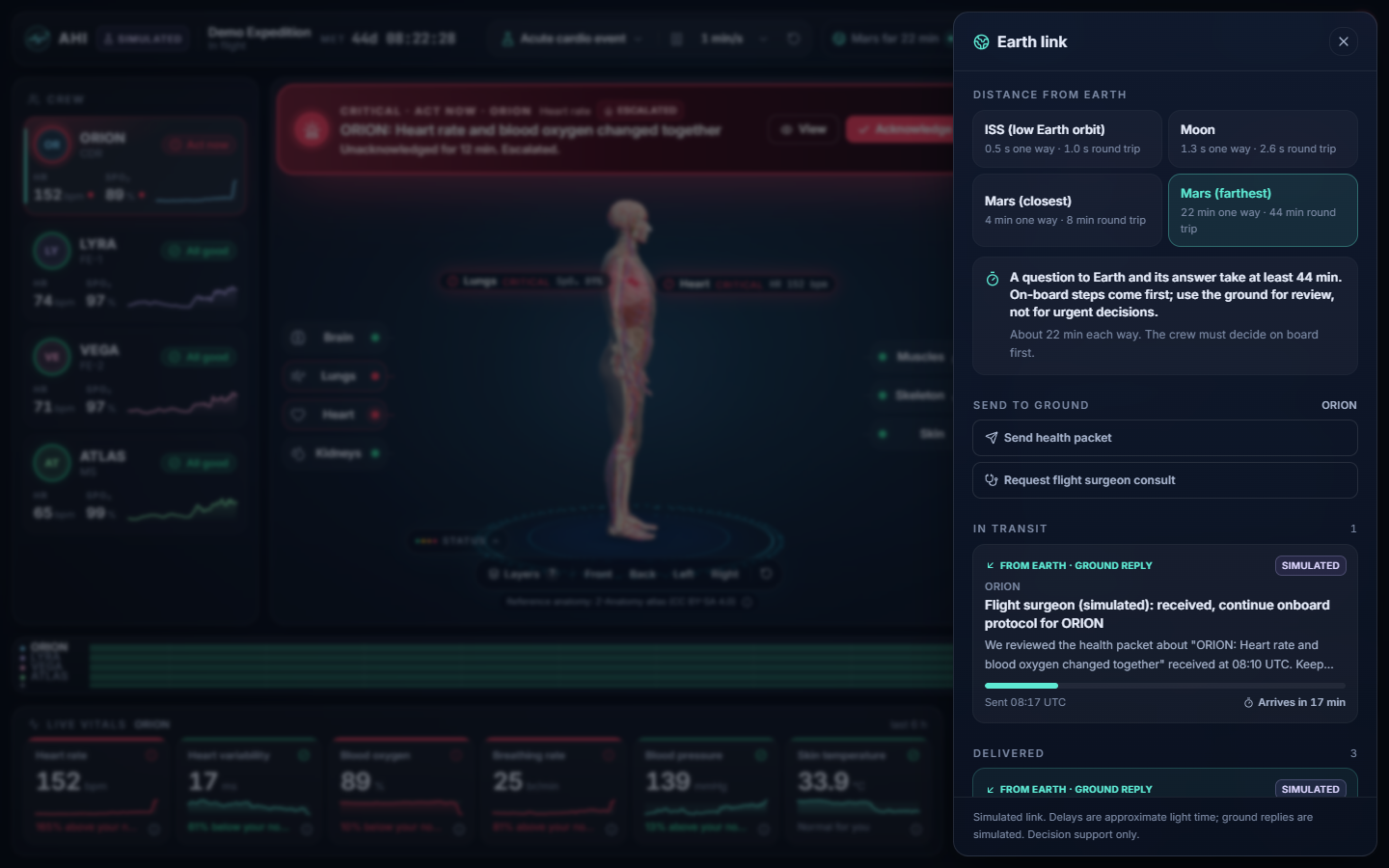
The Earth link simulates the communication delay between the vehicle and Earth. Messages take the one way light time of the active profile, a simulated flight surgeon reviews and replies, and under Mars delays the crew gets an on board first step (Recommendations).
Inputs
| Profile | One way delay | Round trip |
|---|---|---|
| ISS (low Earth orbit) | 0.5 s | 1 s |
| Moon | 1.3 s | 2.6 s |
| Mars (closest) | about 4 min | about 8 min |
| Mars (farthest) | about 22 min | about 44 min |
Delays are approximate public figures for light time, in catalog.ts.
Method
arrivesAt     = sentAt + one way delay
reply sentAt  = delivery time + review time (4 to 8 sim min, seeded per message)
earliest answer to a question = 2 x one way delay + 4 min- Status is
IN_TRANSITuntil the sim clock passesarrivesAt, thenDELIVERED. Timing does not depend on how often the engine runs (tested). - Health packets are sent automatically once per alert reaching HIGH or CRITICAL; consult requests and handover reports are sent by a person.
- The simulated reply acknowledges, asks to continue the onboard protocol and to re-check in 10, 30, 60 or 120 min (CRITICAL, HIGH, MODERATE, LOW). It never prescribes medication and says it is simulated. Handover reports get no reply.
- Messages already in transit keep their arrival time when the profile changes.
Outputs
CommMessage (direction, kind, title, body, sentAt, arrivesAt, status, related alert or recommendation, data_origin), audit events COMM_SENT, COMM_RECEIVED, COMM_PROFILE_CHANGED, and the Earth link drawer.
Limitations
No real communication system is involved. Delays, review times and replies are demo configuration (COMMS in config.ts); ground replies are templates, not medical advice. Bandwidth, blackouts and message loss are not modeled.
Status
Implemented Covered bycheckins.test.ts (8 tests: pre-generation, metrics, morning check-ins, fatigue and CO2 effects, manual replacement, MODERATE cap with no alert, high fatigue run) and comms.test.ts (9 tests: delivery and reply timing, independence from processing rate, non-prescriptive replies, automatic health packets, on board first step under Mars and not under ISS, audit).Next steps
- Mission features: how both look in the app.
- Alerts and escalation