
Risk Assessment
What it does
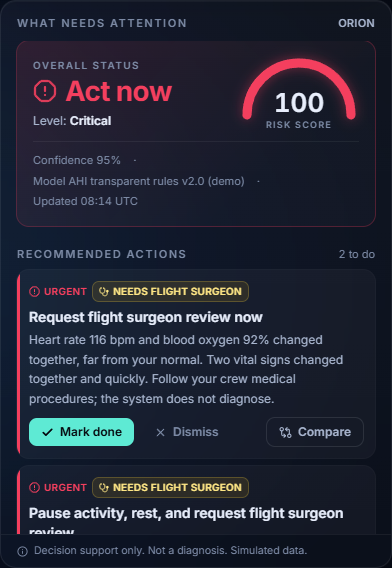
The Astronaut Health Intelligence Platform (AHI) combines the rule hits of one astronaut (from Anomaly detection, combined rules, cabin rules and self report) into an operational attention level (LOW, MODERATE, HIGH, CRITICAL), a risk score from 0 to 100, the contributing factors in plain language, a confidence value and a calm one sentence headline. It also gives each body region a status for the 3D body.
Attention levels, not medical classifications
The levels are operational levels of the prototype (spec section 9.5). They are not diagnoses, not validated clinical categories and not a probability of any medical event.
Inputs
| Input | Detail |
|---|---|
| Metric rule hits | One per triggered rule id with its worst level, from each MetricTracker |
| Combined rules | R-CARD-01, R-FAT-01, R-ENV-CO2-02 (below) |
| Cabin rule hits | Count in every crew member's score: everyone breathes the same air |
| Self report | R-PSY-01 to R-PSY-04 from the daily check-in |
| Data availability | Missing or questionable key signals and unready baselines |
Method
Combined rules
| Rule | Condition (as coded) | Level |
|---|---|---|
| R-CARD-01 | Heart rate and SpO2 both at HIGH or worse at the same time | CRITICAL |
| R-FAT-01 | Two of: short sleep or low sleep efficiency (MODERATE or worse); HRV below normal (MODERATE, or drift of at least 1.2 robust SD down); resting heart rate drift of at least 1.0 robust SD up | MODERATE; all three: HIGH |
| R-ENV-CO2-02 | Cabin CO2 at MODERATE or worse while breathing rate drifts up (at least 0.8) or reaction time is at least 2 robust SD slower | MODERATE (co-occurrence, not proof of cause) |
Combined rules suppress their components in the alert list (one grouped alert instead of five), so the person sees the pattern, not five fragments. Missing data never counts as a normal component. High self reported fatigue (4 or 5 out of 5) in the last 2 check-ins adds the factor "You also reported high fatigue in your last 2 check-ins" to R-FAT-01 without raising its level.
Score (noisy-OR)
Each triggered rule contributes one weight, from the worst level of that rule:
| Level | Weight w |
|---|---|
| MODERATE | 0.20 |
| HIGH | 0.45 |
| CRITICAL | 0.85 |
risk_score = round(100 x (1 - product over rules of (1 - w_i)))

LOW < 20 <= MODERATE < 45 <= HIGH < 80 <= CRITICAL| Variable | Meaning |
|---|---|
w_i | Weight of rule i (one per rule id, worst level) |
1 - w_i | "Share of attention left" after rule i; the product is the share left after all rules |
risk_score | 0 when nothing triggered, approaches 100 as rules accumulate |
Interpretation. Several independent moderate deviations escalate by construction, without exceeding 100. Example: three MODERATE rules give 100 x (1 - 0.8^3) = 49, which is HIGH. One HIGH rule alone gives 45 (HIGH); one CRITICAL rule gives 85 (CRITICAL).
Assumptions. Rules are treated as roughly independent signals; weights are demo values chosen so that the levels behave sensibly on simulated scenarios.
Caps and special weights
| Rule of the score | Why |
|---|---|
| CRITICAL requires at least one CRITICAL rule; otherwise the score is capped at 79 | Slow multi day patterns call for review, not an emergency response |
| Data quality rules weigh at most 0.20 | A lost signal means "unknown", not "worse" |
| Self report rules share one weight (the largest) | A check-in alone reaches MODERATE at most |
| A reported symptom (R-PSY-04) weighs 0.05 | Informational, stays LOW on its own |
| Cabin rules count in every crew member's score | Shared environment |
Confidence
confidence = 0.95
           - 0.15 per missing key signal       (HR, HRV, SpO2, breathing rate, sleep)
           - 0.07 per questionable key signal
           - 0.05 per key baseline not READY
clamped to [0.15, 0.95]
Confidence says how much data is behind the level, not how likely the level is to be right. When core vitals are missing the UI says "Status cannot be confirmed".
Body regions
Each region takes the worst status of its metrics and of the rules mapped to it. A region whose metrics are all missing is NO_DATA; an unmonitored region is NO_DATA, never LOW.
Outputs
RiskAssessment (spec section 9.5):
| Field | Content |
|---|---|
risk_level, risk_score | Level and 0 to 100 score |
contributing_factors | Plain-language factors with weights, for example "HRV 28% below personal baseline for 3 days" |
triggered_rules | Rule ids |
confidence | 0.15 to 0.95 |
model_version | AHI transparent rules v2.0 (demo) |
evaluated_at, data_window | When and on which window |
limitations | Always includes: simulated data only; decision support, not a diagnosis; thresholds are demo configuration; correlation does not prove cause; plus missing signals |
headline | One calm sentence, for example "All indicators are within your normal range." |
Limitations
- Weights, bands and caps are demo configuration, tuned on the same simulator that produced the data.
- The score is not calibrated as a probability and must not be read as one.
- Independence between rules is an approximation (for example sleep and HRV are related).
- Only three combined patterns exist; other relationships are not modeled.
Status
Implemented Covered byrisk.test.ts (14 tests: bands, noisy-OR escalation, caps, data quality weight, R-CARD-01, R-FAT-01, missing data as a component, assessment output, headlines, regions, alert dedupe, actionability, grouping, recommendations). Spec requirement: US-020.