
Personal Baseline
What it does
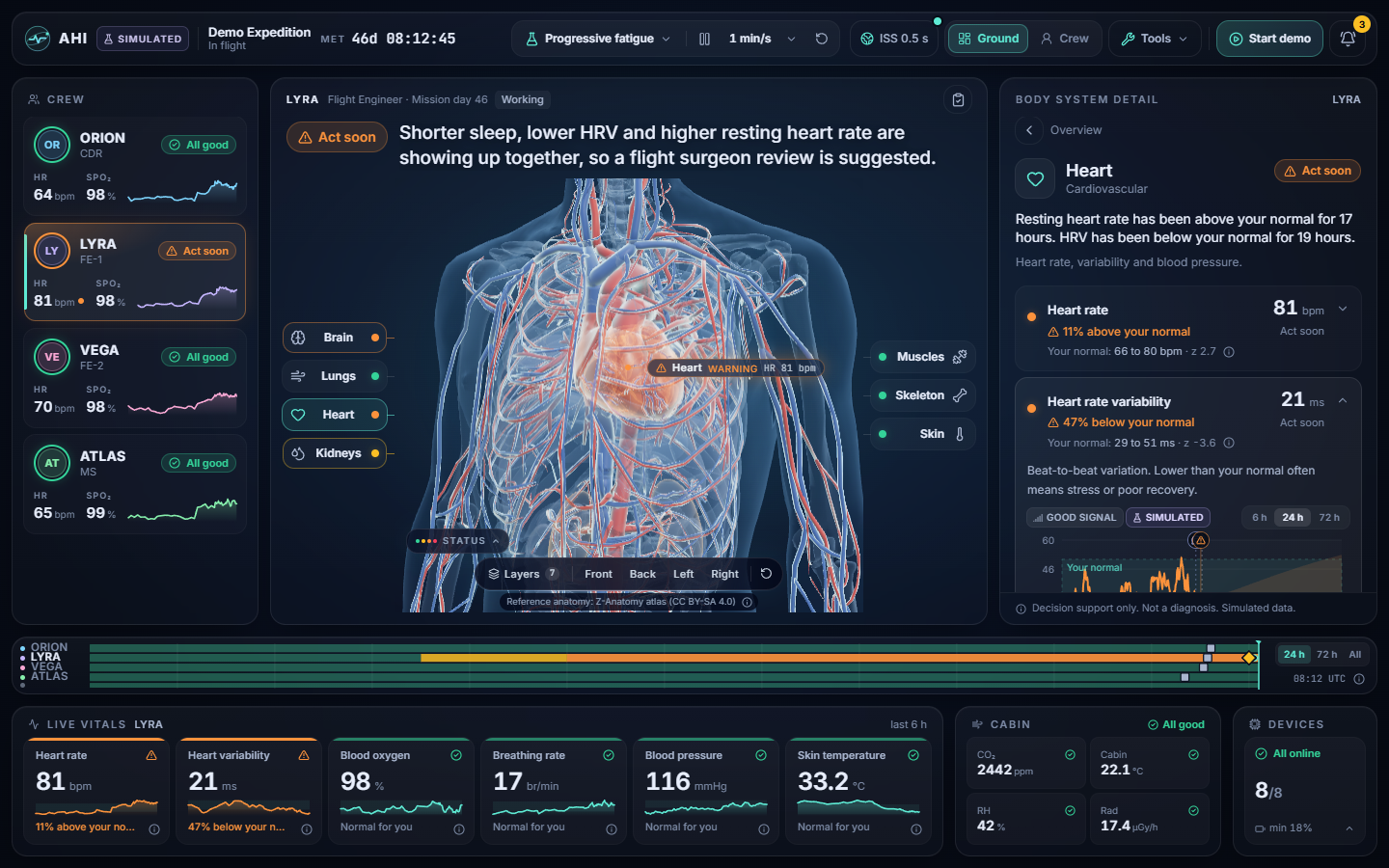
The Astronaut Health Intelligence Platform (AHI) compares each astronaut with their own recent values, not with a population average. For every person, metric and activity context it keeps a robust estimate of "normal" and a band around it. Everything downstream (anomaly detection, risk, forecasts, the shaded "Your normal" band on charts) uses this baseline. Why personal ranges matter in spaceflight physiology: Monitored physiology.
Inputs
| Input | Detail |
|---|---|
| Accepted samples | Valid observations of one subject and metric, at 5 min resolution for continuous metrics, one per event for daily metrics |
| Activity context | From the simulated schedule: SLEEP, REST, WORK, EXERCISE (exercise, EVA and 20 min of recovery after exercise count as EXERCISE) |
| Metric configuration | minScale, bucketed, physical limits, from METRIC_RULES in config.ts |
| Startup history | 5 days of minute level history and 14 days of daily metrics are pre-generated, so baselines are ready immediately |
Method
Robust statistics
For the samples x1 ... xn in a context bucket:
median   m   = median(x)
MAD          = median(|x_i - m|)
robust SD  s = max(1.4826 x MAD, minScale)
band = [m - k s, m + k s] with k = 2, clamped to the metric's physical limits| Variable | Meaning | Demo value |
|---|---|---|
m | Center of the person's normal | |
MAD | Median absolute deviation, a spread measure that ignores outliers | |
1.4826 | Makes MAD comparable to a standard deviation for normally distributed data | constant |
minScale | Floor per metric so a very stable signal does not make tiny changes look huge (for example 3.5 bpm for heart rate, 0.7% for SpO2) | per metric |
k | Band half width in robust SD | 2 |
The baseline also stores the mean, SD, p05 and p95 (for display and diagnostics), the sample count n, a window label and the version robust-baseline v1 (median/MAD).
Interpretation. The band is "where this person usually is in this context". A value outside it is unusual for them, which is not the same as clinically abnormal.
Assumptions. Recent history represents the person's normal; the context from the schedule is correct; a spread of 2 robust SD is a reasonable "usual range" for a demo.
Context buckets
Physiological metrics keep one baseline per context (SLEEP, REST, WORK, EXERCISE). A workout is compared with past workouts, so exercise never raises a heart rate alarm by itself. Daily metrics, hydration and cabin metrics use a single bucket.
Sample size and readiness
| Kind | Minimum samples for READY | Reservoir |
|---|---|---|
| Continuous metric, per context | 72 | 5 days at 5 min (1,440 values) |
| Exercise context | 36 | same |
| Daily (event) metric | 5 | 28 values |
Below the minimum the baseline is INSUFFICIENT_DATA and the UI says "Still learning your normal". No status is derived from an unready baseline.
Outlier and drift gate
A sample enters the baseline only if:
- its robust z is below 3.5 (continuous) or 2.5 (daily),
- the drift indicator (EWMA of z) is below 1.0,
- it is not
QUESTIONABLE.
If drifting samples entered the baseline, a slow decline would quietly become the new normal. The gate keeps them out until the drift clears.
Recompute schedule
The reservoir is a fixed size ring buffer (O(1) per push). The bucket baseline is recomputed every 24 accepted samples (2 sim hours), never on every tick (every 144 samples while pre-generating history).
Outputs
| Output | Where it is used |
|---|---|
Baseline record: status, n, median, mad, mean, sd, p05, p95, low, high, windowLabel, version | MetricState.baseline and contextBaselines |
| Normal band | Shaded "Your normal" band on the trend chart; "Your normal: 66 to 80 bpm" in metric rows |
| Robust scale | z-scores in Anomaly detection, band exit in Forecasting |
| "Why is this my normal?" | The info button shows window, readings, median, MAD and version |
Limitations
- Context comes from the schedule, not from sensor based activity recognition.
- The band reflects recent days only; a long, slow adaptation to spaceflight would move it (by design, but it must be reviewed by a person).
minScalefloors andk = 2are demo configuration, not validated values.- With little history (new crew member, new device) there is no baseline, only
INSUFFICIENT_DATA. - Baselines are built from simulated data; no real crew data has been used.
Status
Implemented Covered bybaseline.test.ts (insufficient data, robust stats, outlier robustness, physical clamping, reservoir), stats.test.ts (median, MAD, scale floor) and anomaly.test.ts (baseline built on normal data, context aware exercise baseline). Spec requirement: US-017.