
Recommendations, Autonomy & What-if
What it does
For every actionable rule hit, the Astronaut Health Intelligence Platform (AHI) picks one non-prescriptive next step from a versioned catalog (rec-catalog v2.0), explains why in plain language, says who can act (crew on board or flight surgeon on Earth) and whether human review is required. A what-if comparison can then show a hypothetical trajectory with and without the action.
Never a treatment
The catalog never recommends medication or a treatment. Items are steps such as "Review sleep schedule and light exposure" or "Request flight surgeon review now".
Inputs
| Input | Detail |
|---|---|
| Rule hits | From Risk assessment, after suppression by combined rules |
| Earth link profile | One way delay of the active profile (Earth link) |
| Current simulated state | For the what-if projection |
Method
Selection
- Actionable hits: any HIGH or CRITICAL rule, plus MODERATE trend, combined, environment and data quality rules. A single acute z blip at MODERATE only changes the status.
- One recommendation per subject and rule per episode (a new episode starts after a 30 min gap), with the rule label as the first part of the rationale and the linked intervention kind.
- Human review: items that are HIGH, CRITICAL or addressed to the flight surgeon have
requiresHumanReview: true. - Cabin items use
astronautId: 'CABIN'.
Catalog (selection)
| Rule | Recommendation | Audience |
|---|---|---|
| R-SLEEP-01, R-SLEEP-02 | Review sleep schedule and light exposure | Crew |
| R-HRV-01 | Review recovery: sleep, workload and exercise intensity | Crew |
| R-FAT-01 | Request flight surgeon review of the recovery pattern | Flight surgeon |
| R-HR-01, R-HR-03 | Pause activity, rest, and request flight surgeon review | Flight surgeon |
| R-CARD-01 | Request flight surgeon review now | Flight surgeon |
| R-SPO2-01 | Check sensor fit, then request review if it persists | Flight surgeon |
| R-EX-01 | Adjust exercise load and recovery with the trainer | Crew |
| R-HYD-01 | Hydrate per protocol | Crew |
| R-RAD-02 | Review accumulated dose with mission control | Mission Control |
| R-ENV-CO2-01 | Ventilate the module and check the CO2 scrubber | Mission Control (on board) |
| R-ENV-CO2-02 | Ventilate and keep monitoring breathing and reaction time | Crew |
| R-ENV-RAD-01 | Follow the radiation shelter procedure from mission control | Mission Control |
| R-DQ-01, R-DQ-02 | Check sensor fit and connection / skin contact | Crew |
| R-PSY-01 | Check in with the crew medical officer and plan some recovery time | Crew |
The full catalog is REC_CATALOG in recommendations.ts.
Autonomy
| Value | Meaning | Typical items |
|---|---|---|
ONBOARD | The crew can act now | Self care, crew medical officer, onboard checks, cabin ventilation |
GROUND_REVIEW | A flight surgeon or Mission Control on Earth should review it | Flight surgeon review, dose decisions |
On board first step. Under the Mars profiles, a HIGH or CRITICAL GROUND_REVIEW item also creates one onboard step per astronaut: "Crew medical officer: start the onboard assessment protocol now". Its rationale states the earliest Earth reply:
earliest reply = 2 x one way delay + 4 min minimum review
               = about 48 min for Mars farthest (22 min one way)
What-if projection
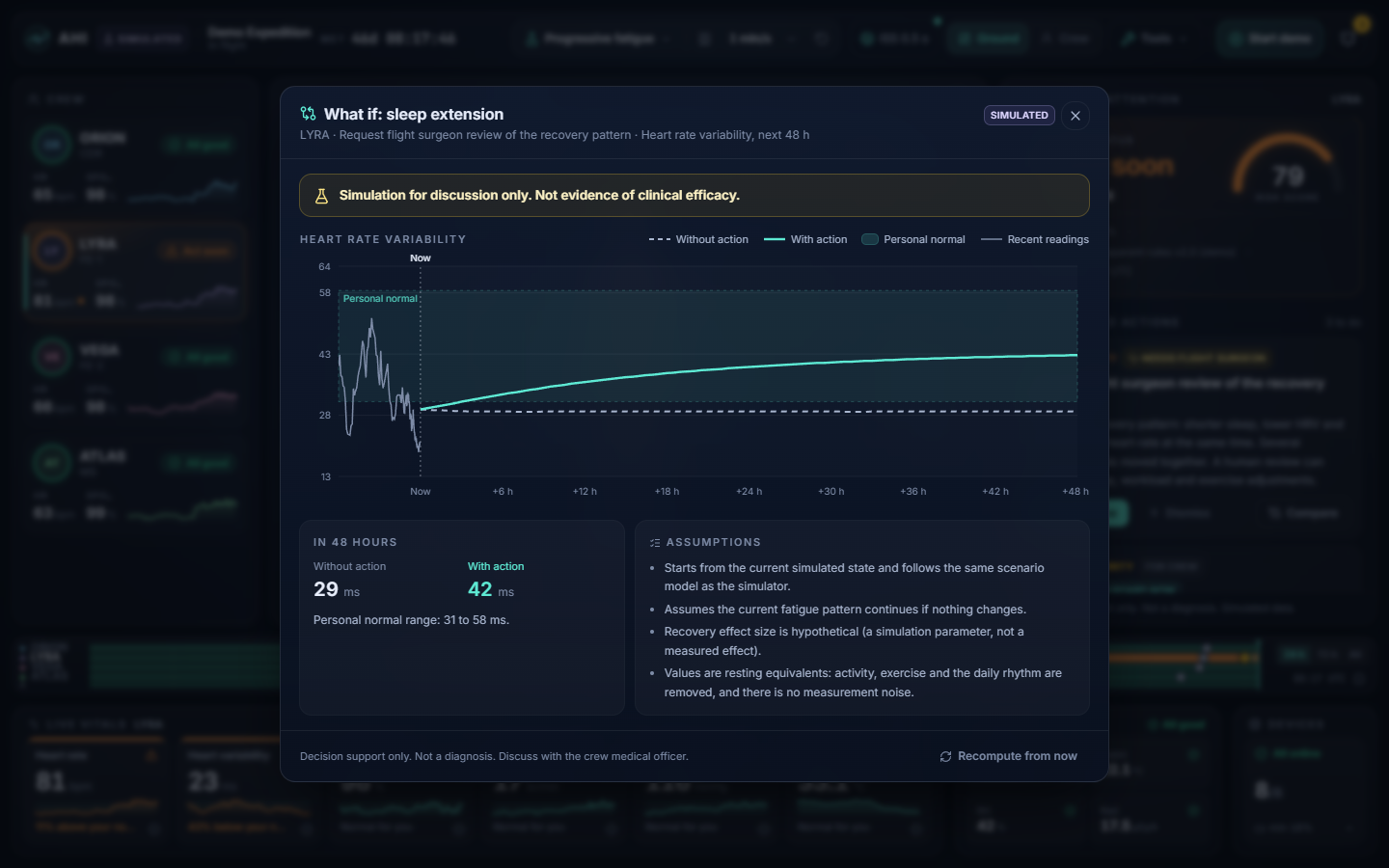
compareIntervention({ astronautId, kind, metric?, horizonHours? }) runs the noise free simulation model twice from the current state: once with a hypothetical intervention logged now, once without. Because both runs use the same deterministic model with noise off, the only difference between the lines is the action.
| Kind | Default metric | Default horizon |
|---|---|---|
SLEEP_EXTENSION | HRV | 48 h, every 30 min |
REST_PROTOCOL, MEDICAL_CONSULT | Heart rate | 24 h; 2 h every 5 min while an acute event is active |
CABIN_VENTILATION | Cabin CO2 | 8 h, every 15 min |
EXERCISE_ADJUSTMENT | Exercise performance | 120 h, one point per planned session |
HYDRATION | Hydration index | 12 h, every 15 min |
SENSOR_CHECK | none |
It is a pure function (no state change, under 5 ms per call) and returns both trajectories, the personal band (rest context), plain assumptions and the disclaimer "Simulation for discussion only. Not evidence of clinical efficacy."
Outputs
Recommendation:ruleId,title,rationale,priority,audience,region,requiresHumanReview,status,interventionKind,active,catalogVersion,autonomy.InterventionComparison:metric,kind,horizonHours,without,with,band,assumptions,disclaimer.- Mark done logs an
Interventionin the audit trail; the simulator then applies a hypothetical relief, recorded as simulation.
Limitations
- The catalog is a demo list written for this prototype, not an approved operational procedure set.
- Intervention effect sizes in the what-if and in the simulator are made up parameters, not evidence; this is why the feature is marked Experimental.
- Autonomy is decided by audience and profile only; real crew authority rules are richer.
- No language model rewrites recommendations. The optional Ask AHI assistant can explain them in plain words, never change them (AI and analytics).
Status
Implemented selection, catalog and autonomy, covered byrisk.test.ts (one per astronaut and rule, human review, linked intervention, actionability) and comms.test.ts (on board first step under Mars, none under ISS). Experimental what-if, covered by intervention.test.ts (7 tests, deterministic, no state change). Spec requirements: US-022, US-023.